
Captura de pantaslla 2026-07-22 161725

Managing Your Spine's Natural Changes

Degenerative Disc Disease in Tampa, FL

Effective treatment for degenerative disc disease in Tampa, FL starts with understanding exactly how your discs have changed, part of regenerative medicine in Tampa, FL centered on your spine, your goals, and your life.

About the Condition

Understanding Degenerative Disc Disease

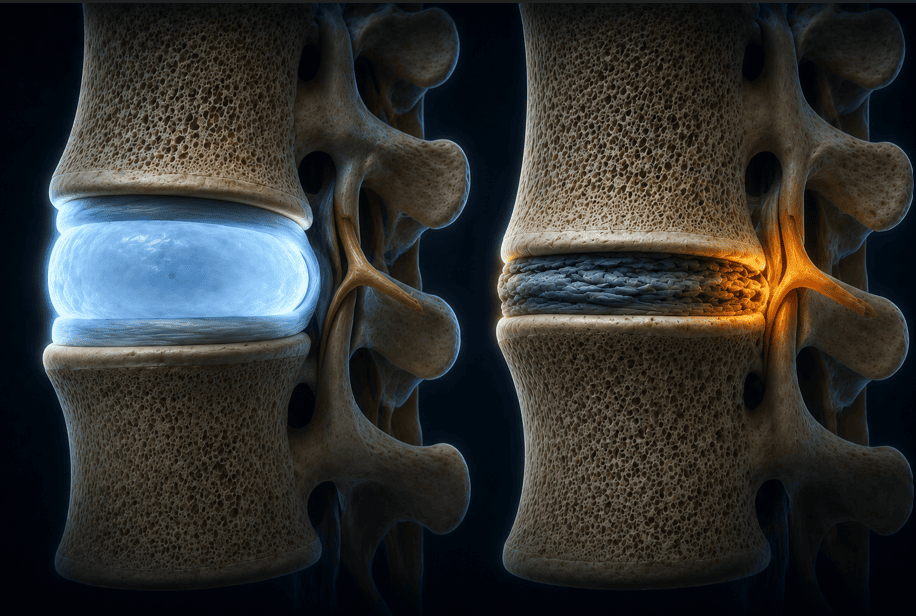
Despite the name, degenerative disc disease, often shortened to DDD, isn't really a disease in the traditional sense. It's a description of the natural wear your spinal discs go through over time, and to some degree, it shows up on imaging for nearly everyone as they age. Each disc has a gel-like center, the nucleus pulposus, that relies on water content to absorb shock and keep the disc plump. As you get older, the center gradually loses hydration and elasticity, the disc flattens slightly, and the tough outer ring around it, the annulus fibrosus, can develop small tears from years of everyday loading.

What makes DDD tricky is that imaging findings and symptoms don't always match. Plenty of people have significant disc changes on an MRI and feel completely fine, while others with milder changes experience real pain. The difference usually comes down to how the disc is loading the structures around it. As a worn disc loses height, the facet joints behind it can begin bearing more weight than they're built for, and nearby nerves can end up with less room than before. That shift in mechanics, not just the wear itself, is often what turns a normal aging process into a source of daily discomfort.


Our Approach

Why We Map Your Spine Before Recommending Treatment

Disc degeneration rarely stays contained to a single level or structure. At DR²SPINE, every evaluation is guided by our Spine as a System approach, looking at the affected disc alongside the facet joints, nerves, and movement patterns it's now interacting with differently, so treatment addresses the actual source of your discomfort instead of the disc in isolation.

Explore the full list of conditions we treat to see how degenerative disc disease connects to other diagnoses we commonly address alongside it.


Common Symptoms

Signs of Degenerative Disc Disease

  • Aching or stiffness in the back or neck.
  • Pain that is worse with certain activities, positions, or after sitting for long periods.
  • Discomfort that comes and goes rather than staying constant.
  • Reduced flexibility or a feeling of tightness in the spine.

Common Causes

What Drives Disc Degeneration

Age is the biggest factor, since discs have a limited blood supply that shrinks further over time, leaving less capacity to repair everyday microtrauma. Repetitive mechanical loading from years of bending, lifting, or sitting adds up gradually. Smoking accelerates the process, since nicotine restricts the small vessels feeding the disc even further. A prior injury can speed up degeneration at that level, even if it healed years ago, and genetics plays a role, too, part of why two people with similar activity levels end up with very different amounts of wear.

Whether degenerative disc disease treatment focuses on a single level or a broader region of the spine depends on how many discs are involved and how the surrounding facet joints and nerves have adapted to the changes. That's why the same diagnosis can call for very different treatment plans from one patient to the next.

pexels-shvets-production-8972326

The DR²SPINE Difference

Why Choose DR²SPINE for Degenerative Disc Disease in Tampa, FL

The provider you choose for degenerative disc disease in Tampa, FL, shapes whether your plan addresses the mechanics driving your pain or simply manages the discomfort day to day. Dr. Myrdalis DĆ­az-RamĆ­rez, MD, is double board-certified in Anesthesiology and Pain Medicine, with more than 25 years in pain medicine and over a decade focused on regenerative care. Your plan starts with a full evaluation and imaging review when appropriate, so treatment is based on which discs and structures are actually involved rather than a general diagnosis. From there, Dr. DĆ­az-RamĆ­rez discusses options designed to reduce pain and support the spine, which may include image-guided injections, regenerative treatments, the M7-MLS laser, and functional medicine support to help calm inflammation.

Who This Approach Helps

Is This the Right Fit for Your Back or Neck Pain?

This approach tends to fit patients who have been told they have disc degeneration but still don't have a clear plan for managing it, as well as those looking for options beyond medication or a wait-and-see approach. It may also fit patients hoping to avoid or delay surgery, or anyone whose pain flares with certain activities but hasn't been fully explained. A full evaluation confirms whether this approach fits your specific situation.


What to Expect

Your Evaluation and Treatment Plan

Your evaluation includes a review of your imaging alongside a discussion of how your symptoms actually behave, since the two don't always tell the same story with DDD. Dr. DĆ­az-RamĆ­rez walks you through which levels are involved and which combination of options is likely to help most, whether that's calming inflammation around an irritated disc, supporting joints that have taken on extra load, or a longer-term plan built around your activity goals. You will leave with a clear understanding of your condition and realistic expectations for treatment. Results vary by person, and candidacy is decided on a case-by-case basis.


In Their Words

Real Patient Stories & Experiences

Explanations only tell part of the story. Read real patient stories & experiences from patients who came to DR²SPINE with degenerative disc disease, and hear how their treatment plans unfolded in their own words.

Searching for degenerative disc disease treatment near Tampa? DR²SPINE starts with an imaging review to confirm exactly which discs are involved before any treatment begins. Call or book online to schedule your visit.


FAQs

Common Questions

What does it mean if I have DDD at more than one level?

Is degenerative disc disease the same as a herniated disc?

Can degenerative disc disease improve without surgery?

Will degenerative disc disease keep getting worse?

How long does degenerative disc disease treatment take to work?

This information is for educational purposes only. Treatments vary by patient, candidacy, and medical necessity. Results vary by person.


Next Steps

Want to Manage Disc-Related Pain and Keep Moving?

Start with a complete evaluation.