
Why Does Spine Pain Rarely Come From Just One Place?
By Dr. Myrdalis Díaz-Ramírez, MD · DR2SPINE · Tampa, FL
You’ve probably had this experience. You tell someone exactly where it hurts, they look at one picture, and they hand you one explanation. Then you go home, and the pain is still there.
If that sounds familiar, I want you to hear this first: you’re not imagining it, and you’re not doing anything wrong. Spine pain is real, it’s exhausting, and it’s rarely as simple as one sore spot. Let me explain why.
Your Spine Is a Functional Unit
Here’s how I think about it. Your spine doesn’t hurt in isolation. It’s a functional unit. The discs, the facet joints, the sacroiliac (SI) joint, the muscles, the ligaments, and the nerves all work together. They share the load, and they share the stress.
So when one part is struggling, the other parts often step in to help. That’s smart, and it works for a while. But over time, those helpers get tired too. Now you have more than one thing that hurts, and sometimes the place that hurts most isn’t the place where the problem started.
That’s why I say pain rarely comes from one isolated structure. It’s more like a chain. If one link is off, the whole chain feels it.
The National Institute of Neurological Disorders and Stroke explains that low back pain can come from many different sources, including disc disease, arthritis, irritated joints, and nerve irritation. You can read more in their low back pain overview. Many causes. Often more than one at the same time.
How Can One Back Have So Many Pain Sources?
Let’s walk through a few of the usual suspects. I’ll keep it simple.
The disc. Think of a disc as a cushion between two vertebrae. When it wears down or bulges, it can irritate a nearby nerve. That can cause pain in the back, and sometimes it travels down the leg. If you want to dig into this one, we have a page on herniated discs and one on degenerative disc disease.
The facet joints. These are the small joints at the back of your spine. They guide your movement. When they get irritated, bending backward or twisting can feel sharp or achy. Learn more about facet joint pain.
The SI joint. It sits where your spine meets your pelvis. When it’s irritated, the pain often shows up low on one side, and it can look a lot like sciatica. That’s why people get confused. You can read about sacroiliac (SI) joint pain too.
The nerves. When a nerve gets pinched or irritated, the pain doesn’t always stay where the nerve is squeezed. It can show up in the buttock, the thigh, even the foot. So the spot that hurts and the spot that’s causing it can be far apart. Our page on sciatica and radiculopathy goes deeper.
The muscles and ligaments. When a disc or joint is irritated, the muscles around it tighten up to protect it. That’s helpful at first. Then the muscles themselves start to hurt. So now you have a second source of pain on top of the first.
See how that works? One problem can quietly create two or three. And that’s exactly why a quick look at one image often doesn’t give you the full answer.
Why an MRI Alone Doesn’t Tell the Whole Story
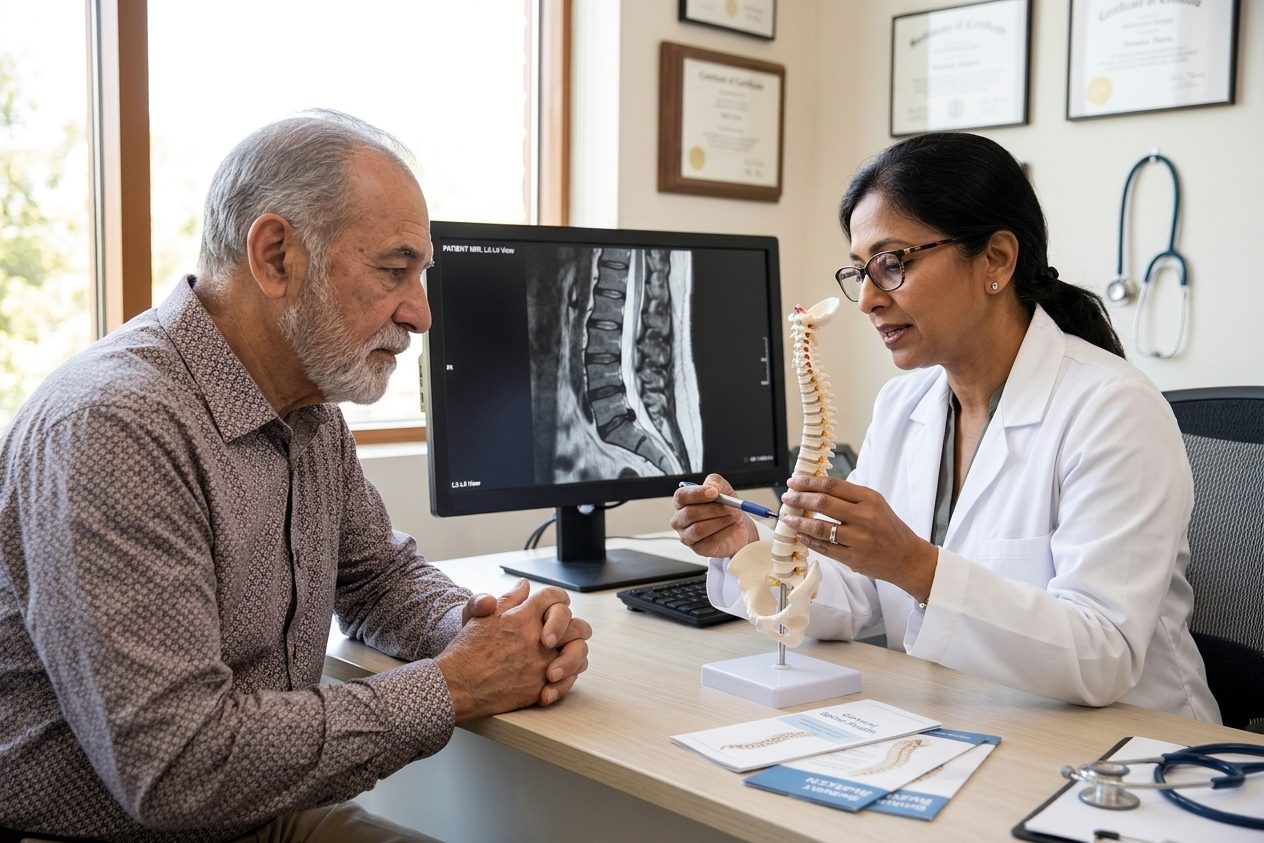
I like imaging. I order it all the time. But an MRI is a picture, and a picture isn’t a person.
I’ve had many patients through the years with a scan that looked scary and almost no pain. I’ve also seen the opposite, a scan that looked fairly quiet and a patient who was really struggling. So the image matters, but it’s only one piece.
The rest comes from listening. Listening to your story, how it started, what makes it worse, what makes it better. Then a real exam, where I look at how you move, where you’re tender, and how the whole spine works together.
And I’ll say this plainly. You’ve probably felt like a number in a rushed visit. We don’t work that way. Your back isn’t a standard problem.
How We Look at the Whole Picture: The DR2SPINE Motion Method
This is the reason I built the DR2SPINE Motion Method. It has five steps: Prime, Map, Target, Repair, Restore.
Prime means we get you ready. We look at things like sleep, weight, and lifestyle, so you can get the full benefit from care.
Map is where this whole conversation lives. We find the true source of your pain, and we look broadly, because the spine is a functional unit. You can see how this connects in our spine as a system overview.
Target means we treat with precision, using ultrasound or fluoroscopy. We don’t inject without looking at what we’re doing.
Repair is where regenerative medicine comes in. Depending on your case, that could include PRP injections, which use platelets from your own blood, or BMAC, which uses concentrated cells from your own bone marrow. We use what’s already inside you, your body’s own repair system. We just help it find the right address.
Restore means we stay with you. I’m the physician who follows your plan of care. We don’t leave you alone after one visit.
Notice that Repair comes after Map and Target, not before. If we don’t know every source of pain, we can’t point the treatment in the right direction. That’s the heart of it.
So What Does This Mean for You?
It means a few things, and they’re hopeful ones.
First, if you’ve been told “it’s just your disc” or “it’s just your muscles” and it didn’t help, that doesn’t mean nothing can be done. It may mean the whole picture hasn’t been mapped yet.
Second, you’re an active partner in this. Your story matters. The small details you share, like when it hurts or what you were doing when it started, help us find the real source.
Third, you don’t have to guess. If you’re not sure whether it’s time to be seen, our guide on five signs you should see a spine specialist is a good place to start.
I can’t promise any specific result, and nobody who’s careful should. Every spine is different. What I can promise is that we’ll look at the whole picture, we’ll explain it in plain words, and we’ll make a plan with you.
Frequently Asked Questions
Can spine pain really come from more than one place at the same time?
Yes, and it’s very common. Your discs, facet joints, SI joint, muscles, and nerves work as one functional unit. When one part is irritated, the others often take on extra work, and then they start to hurt too. That’s why we look at the whole spine, not just the sore spot.
Why can an MRI look serious when the pain is mild, or look quiet when the pain is strong?
An MRI is a picture, and a picture isn’t a person. Some patients have a scary-looking scan and very little pain. Others have a fairly calm scan and a lot of pain. That’s why your story and a real exam matter just as much as the image.
How does a spine doctor find every source of my pain?
It starts with listening. You tell your story first. Then we do a thorough exam, look at how you move, and review your imaging together. In the DR2SPINE Motion Method, that’s the Map step, and it’s where we find the true sources before we treat anything.
Can spine pain show up in my buttock, leg, or foot?
It can. When a spinal nerve is pinched or irritated, you may feel it far from the spine. That’s why the spot that hurts and the spot causing the problem can be in two different places. Mapping helps us trace it back to the spine.
Are PRP injections or BMAC right for every kind of spine pain?
No. Every spine is different, and no treatment fits everyone. PRP uses platelets from your own blood, and BMAC uses concentrated cells from your own bone marrow. Whether either one makes sense for you depends on what we find when we map your pain, and I can’t promise any specific result.
Do I have to have surgery if my pain has more than one source?
Not necessarily. DR2SPINE focuses on non-surgical, regenerative spine care, and we don’t manage opioids. After we map and target your pain sources, we’ll talk through your options together and build a plan you’re comfortable with.
Ready to Look at the Whole Picture?
If you’re in the Tampa area and you’re tired of chasing one answer at a time, let’s take a closer look together. You can see how we approach spine care and our services, or you can sign up for the masterclass to learn more at your own pace.
Are you ready? Let’s go.
Dr. Myrdalis Díaz-Ramírez, MD, is a double-board certified physician with 25+ years of experience, including minimally invasive spine surgery and a full spectrum of regenerative and pain management therapies. This article is for education and isn’t a substitute for a medical evaluation.
